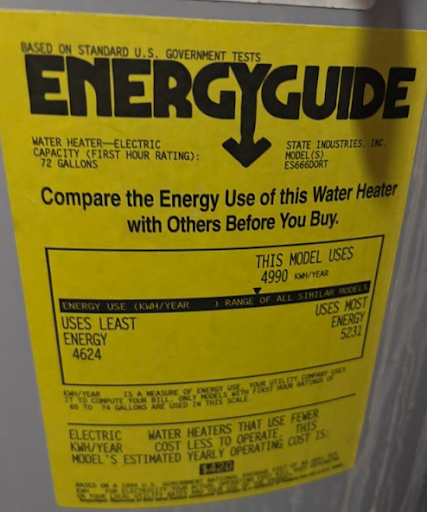
Ever wondered what these stickers mean? They’re produced by the Energy Star program, and are a way of comparing the energy use of one appliance to another of a similar type. The first example shown here indicates a mid-range efficiency unit (for a standard electric water heater), using 4,990 kwh/year (indicated by the small black arrow on the top of the black line) versus 5,231 kwh/year for the least-efficient unit. That amount of electricity costs about $750 per year for the mid-range unit versus under $700 for the most efficient unit of this type
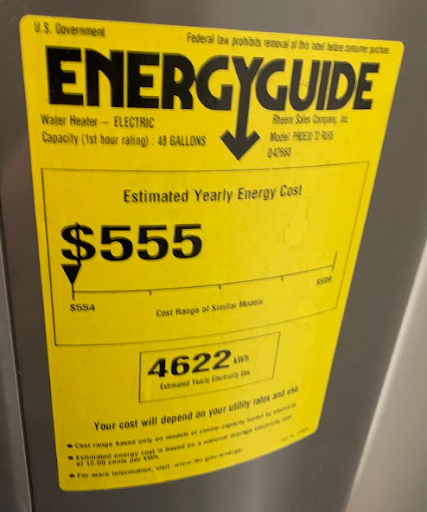
Mid-range is not bad! But what we really like to see is one like the label below, with the indicator arrow all the way over to the left (indicating most efficient for that type of appliance). This one is in dollars instead of energy used, but same idea: far left = most efficient.
However! There’s an important catch.
What these stickers don’t tell you is that there’s a whole other type of electric water heater that’s the most efficient by far: The heat pump water heater. Below is an image showing the Energy Guide label for that type of water heater next to a traditional electric water heater.
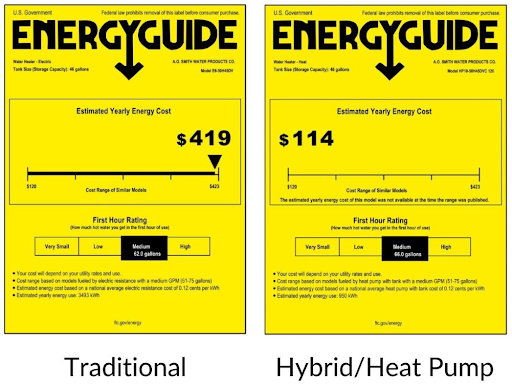
$114 per year vs. $419 per year is a big difference - and the savings just get larger for a bigger unit (this is for a 50-gallon tank).
What’s the takeaway lesson here? When you buy a water heater (or any other major appliance, don’t ask for the unit that’s cheapest to install. Check out the EnergyGuide label, and let your installer know you want the best quality unit that’s cheapest to operate. The energy and the cost savings are huge, and will easily pay for the cost difference over the life of the appliance.
NOTE: heat pump water heaters make noise when they run - think a little louder than a dishwasher - and they need at least a 10’x10’ area to operate properly (or a vented access to the outside or a larger room). That means they work best in a basement, attic, utility room or other space where noise concerns and air flow aren’t a limitation.